Projects & Funding
Our research on the mechanics of soft interfaces is organized around several funded projects. Open positions on these projects are listed under Openings.
Viscocrack
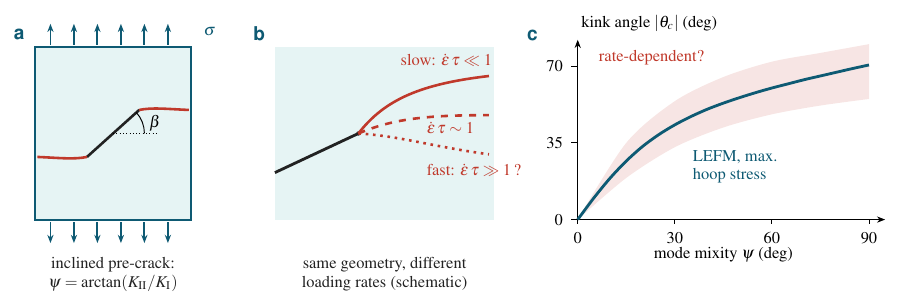
Crack path prediction and control in nonlinearly viscoelastic materials.
Tough hydrogels, elastomers, and soft tissues are increasingly built into medical devices and soft robots, yet we cannot reliably predict where a crack in such a material will go. Viscocrack attacks this through four coordinated aims — materials development at EPFL, phase-field modeling at UCLA, and experiments at Aix-Marseille Université on how nonlinearly viscoelastic cracks select their paths under mixed-mode loading, and on steering cracks by patterning the material with light.
Funding: SNSF–NSF Lead Agency Grant 219301 (786 kCHF), ending August 2028. Partners: UCLA (L. Jin), EPFL Soft Materials Laboratory (E. Amstad), IRPHE (M.-J. Dalbe).
The Hierarchy of Scales
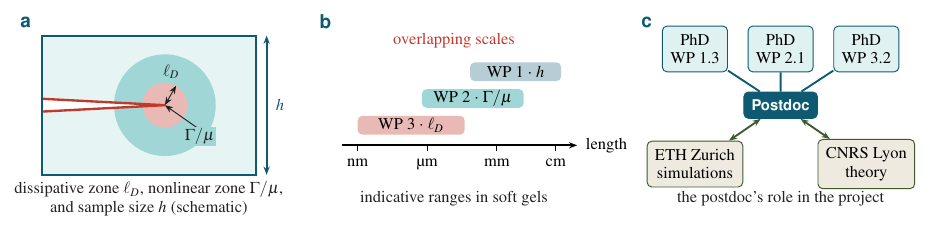
The hierarchy of scales in the fracture of soft and slender bodies.
Whether and how a soft solid breaks depends on several length scales at once: the thickness of the body, the nonlinear-elastic zone near the crack tip, and the region over which energy is dissipated. In soft materials these scales can be comparable, so classical fracture theories — which assume their strict separation — break down. The project addresses each scale in a dedicated work package, combining experiments at Aix-Marseille Université with simulations at ETH Zurich and analytical theory in Lyon.
Funding: SNSF Project Grant 236406 (750 kCHF), 2025–2029. Partners: ETH Zurich (D. Kammer), CNRS Lyon (M. Adda-Bedia). An international workshop on soft fracture will be held at Monte Verità (Ascona) in November 2027.
Suspfrac — fracture of shear-thickening suspensions
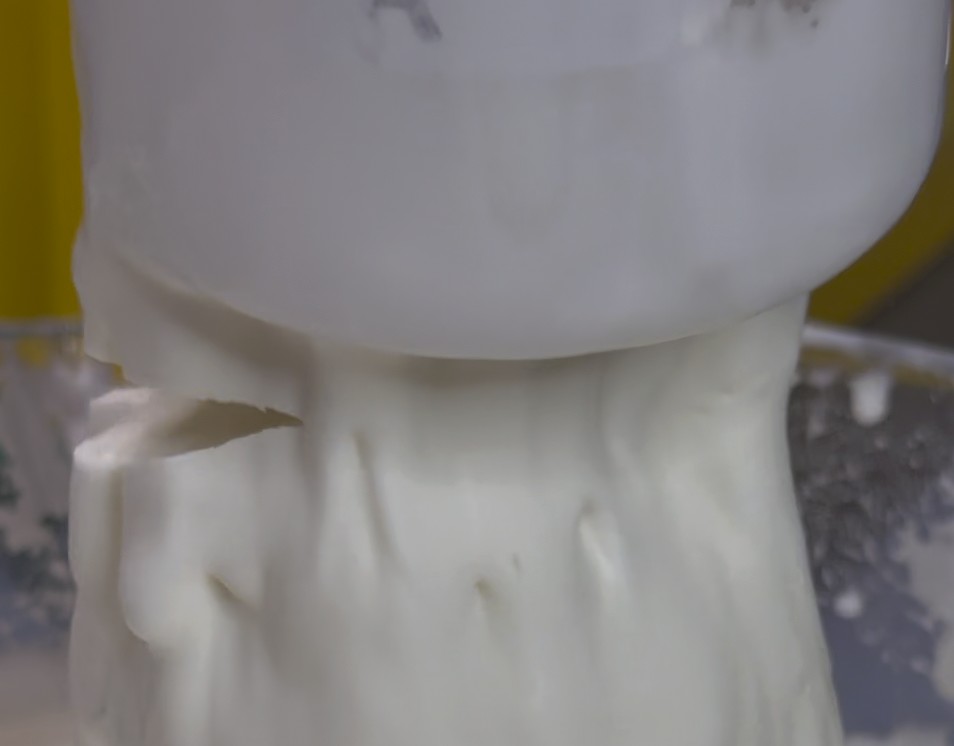
How do liquids break?
In dense particulate suspensions such as water–cornstarch mixtures, the viscosity jumps sharply above a critical shear rate, and under large stresses these shear-jammed fluids can form sharp, crack-like fractures reminiscent of brittle solids. We investigate how such cracks nucleate and propagate in a medium made of non-cohesive particles that, a priori, cannot sustain tension — using controlled confining-pressure experiments with the Capillarytron rheometer to measure how mechanical energy is stored and released in the shear-jammed state. The work bridges fracture mechanics, granular physics, and non-equilibrium rheology, with implications ranging from landslides and fault gouge to impact-resistant materials.
A joint project in the IUSTI Particulate Flow Group with Bloen Metzger and Yoël Forterre, with theoretical and numerical collaborators at IUSTI (AMU).
Funding: ANR and AMIDEX — project Suspfrac, “Fracture of dense cohesive suspensions.”